
After the litter box and the “what if they run away” question, this is the next thing people ask when they hear I travel full-time with two cats: what about the vet?
Three years in, Boudica and Pooka have never had a home vet. Every vet is a new vet. And that has turned out to be completely manageable, with a little paperwork, one phone reminder, and a willingness to leave a waiting room when the vibes are off (more on that below). This is the whole system.
Keep Your Cats’ Records in Three Places
Vet records are the one thing you cannot improvise on the road. When every vet is a new vet, the paperwork is the only continuity your cat has, and some things flat-out require it:
- Boarding. No kennel or cat sitter worth using will take a cat without current vaccine records.
- Border crossings. Mexico and Canada both want proof of rabies vaccination, and you do not want to be digging for it at a checkpoint.
- Your own memory. Some shots are good for three years, which sounds easy to track until year two, when you have no idea what month it was or which state you were in.
My setup is boring and bulletproof:
- A paper copy in the glove box of the van. Vet offices still love paper.
- A photo of every page in a Google Drive folder, so it’s on my phone anywhere I have signal.
- A copy on my laptop for the days with no signal at all.
Three places, zero scrambling. Any new vet gets the folder handed to them on my phone and we’re off.
How to Find a Vet in a Strange Town
- Look for a community vet, not the fancy building. The sleek corporate animal hospital will take beautiful care of your cat and you will pay through the nose for it. Small local practices have, in my experience, cared just as much and charged a lot less. Some will even do vaccinations at cost if money is tight. I’m not saying anything about the quality of care at the big places, only that my wallet remembers them.
- Check who owns the clinic. Private Equity Vet keeps a searchable map and list of corporate and private-equity-owned practices across the US and Canada. If a clinic is on it, expect corporate pricing. If it isn’t, you’re probably looking at a vet who owns their own shop.
- Read the reviews, and make sure they see cats. Not every clinic is a cat clinic, and a vet who mostly does cattle is not who you want examining Pooka.
- Just call. I try to book online every single time and every single time it’s a nightmare. The phone call is faster, even for a socially anxious person like me, and you can ask about fees before you walk in.
- Say what you want: in and out. When I need a vet, I’m paying cash and I want a quick, competent visit, not the whole production of a human hospital. Community vets get that immediately.
The 5:05 Ambush (or, Ask About Fees Twice)
One afternoon Pooka went weird. Calm, lethargic, not herself. I was sure she’d been bitten by something, so we called the only vet around, one of the fancy ones, and asked specifically whether we’d be charged the $200 after-hours fee if we arrived a few minutes past five. They said no.
We walked in at 5:05. They told us the fee applied. We reminded them of the phone call. The answer, roughly, was that they didn’t care.
Meanwhile, somewhere on the drive over, Pooka had perked up entirely. Something about the van moving snapped her out of it, and by the time we were sitting in the waiting room, she was her normal self and clearly fine. Probably a bee sting. Definitely not an emergency, and definitely not worth $200 plus an exam fee I’ve since blocked from memory. So we put her back in the carrier and, with great dignity, slipped out to the parking lot and drove away.
Two lessons:
- Confirm fees on the phone, then confirm them again at the desk before anyone touches your cat.
- Cats bounce back fast from small things. Take the real symptoms seriously, but give the drive a minute to tell you what you’re dealing with.
Vaccines While Traveling
The only vet visits my cats have needed on the road have been routine: renewing rabies and the FVRCP combo vaccine, mostly so they could be boarded and so nobody catches rabies in the woods. The AAFP explains why cats need these core vaccines even when they live indoors, and travel only adds to the exposure. A community vet handles these in one short visit, and the records go straight into the three-places system.
Flea and Tick Prevention Is Not Optional Out Here
Your cats are going to meet fleas and ticks in the woods. If you do nothing, your van or RV will have fleas, and believe you me, you do not want your bed to have fleas.
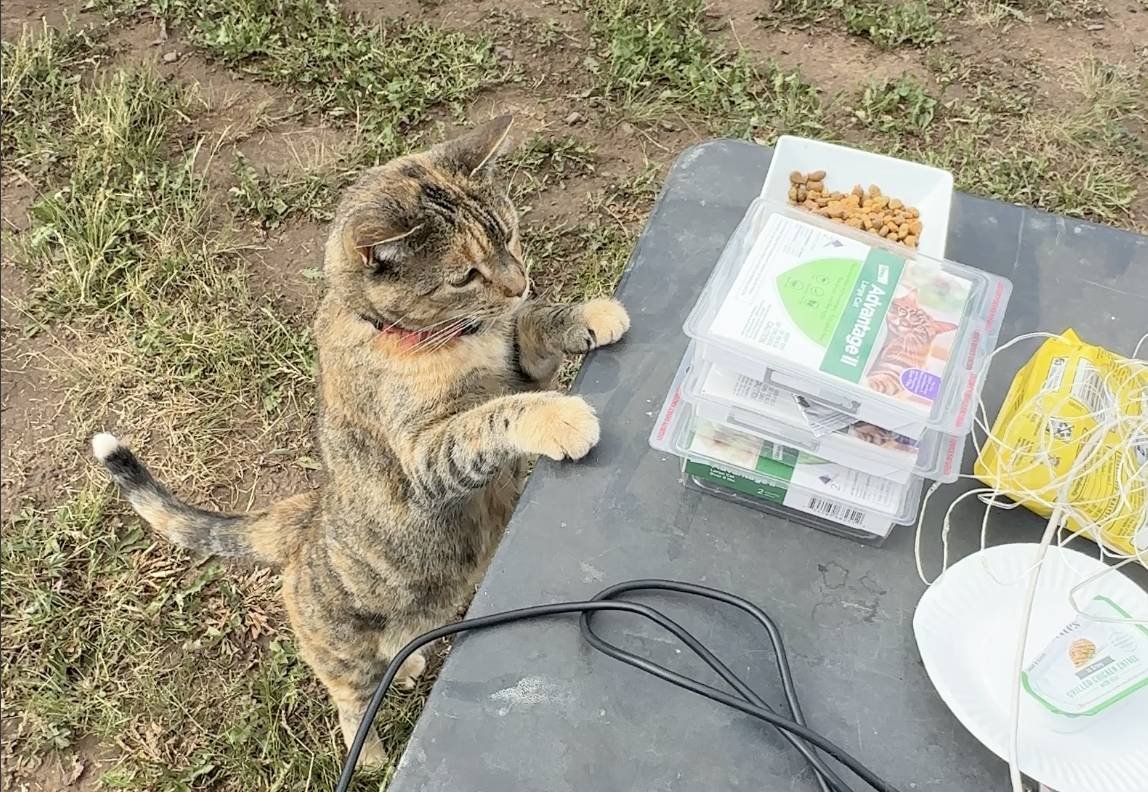
- Monthly topical flea and tick medication, every month, no exceptions. I buy the cat-specific packs you can find at any Walmart, around $30 to $50 for a two- or three-month supply, and I keep a stash in the back so I never run out in a small town.
- Set a phone reminder. Mine goes off once a month, I put the drops on both cats, and that’s the whole chore. The reminder is the system. Without it, I would absolutely forget.
- Cat products only. The AAFP is blunt about this: many flea and tick products made for dogs contain permethrin, which is toxic to cats. Read the label, and ask a vet which product fits your cat.
- Skip the flea collars, and skip the peppermint oil. None of that does anything. Your cats need real flea and tick medication.
- Ask about prescription options. Products like Revolution are prescription-only and work systemically, meaning they’re absorbed into the bloodstream so the fleas that bite your cat get dosed. Worth asking a vet about if you’re deep in tick country.
- If they already have fleas, the medication takes a couple of days to stop the bites in your blankets. Do your laundry. All of it.
Build a Pet First Aid Kit (and Don’t Freelance With It)
I keep a pet first aid kit in the van, and the AVMA has a pet first aid supplies checklist that covers the essentials:
- A copy of your pet’s medical records (see: three places)
- Phone numbers for a vet, an emergency hospital, and poison control
- Gauze, nonstick bandages, self-adhering tape, and blunt scissors
- Clean towels, which the AVMA specifically recommends for restraining cats
- A digital thermometer, tweezers, disposable gloves, a small flashlight
- Saline solution for flushing eyes and wounds
- An eye dropper or needle-free syringe
The rule that matters more than the kit: call a vet or poison control before you put anything on or in a cat. Cats lick everything. Any ointment, cream, or medication you apply, they will try to eat, and the AVMA is clear that first aid is a bridge to the vet, not a replacement for one.
The Emergency Plan Is Simpler Than You Think
People picture van life as being hours from civilization with a sick cat. Mine isn’t. I’m usually within an hour of a vet, and I don’t know where y’all are camping, but most of us are closer to a town than the fantasy suggests.
- If a cat gets hurt or sick at camp, I rush to the nearest vet. That’s the plan. It’s a good plan.
- I run an emergency fund instead of pet insurance. Set aside what a bad week at the vet would cost and keep it there. If you plan to use the big expensive hospitals, insurance may make sense for you. If you pick your vets wisely and pay cash, the fund has covered everything I’ve needed.
- Televet is an option now. I’ve never used one, but with Starlink in the van, a video call with a vet from a dispersed campsite is possible, and it’s a sensible first move for “is this an emergency or a bee sting.”
And if your biggest fear about taking your cat on the road is being far from help: park nearer to vets. You’re not without control over where you go. Stay closer to towns and busier places until you and your cat have some miles under you. Easy peasy.
Vet Care on the Road: Quick Checklist
- Records in three places: glove box, Google Drive, laptop.
- Community vets over corporate hospitals, and check who owns the clinic before you book.
- Call, don’t book online. Ask about fees on the phone and again at the desk.
- Keep rabies and FVRCP current so boarding and border crossings stay easy.
- Monthly flea and tick drops with a phone reminder. Cat-specific products only. No collars, no essential oils.
- A pet first aid kit built from the AVMA list, and a vet on the phone before you use any of it.
- Emergency fund over insurance unless you’re committed to the expensive places.
- Worried? Camp closer to towns. You get to choose.
Three years, two cats, a few vaccine visits, one bee sting, and one dramatic parking-lot escape. That’s the entire vet history of our road life, and I’ll take it.
Sources
- American Veterinary Medical Association: Pet first aid supplies checklist
- American Association of Feline Practitioners, Cat Friendly Homes: Parasite Prevention and Why Does My Cat Need to Be Vaccinated?
Leave a Reply