
I’m writing this during a gray week. No sun, no solar, and the battery that runs my fridge and laptop is getting charged off my other battery like a kid borrowing lunch money from a sibling. So yeah, I’ve been thinking about solar a lot lately.
The Quick Answer
- Point portable panels south if you’re in the Northern Hemisphere. Most of the day’s sun comes from the southern sky.
- Tilt them about as steep as your latitude. Go steeper in winter when the sun is low, and flatter in summer when it’s high.
- If you want to set it once, aim south and walk away.
- If you want every last watt, re-aim three times a day: southeast in the morning, south at midday, southwest in the afternoon.
- Keep them out of the shade. Even a little shade on one corner can drag the whole panel down.
Which Direction Should Portable Solar Panels Face?
South, if you’re anywhere in the U.S. The sun rises in the east, swings across the southern sky, and sets in the west, so a panel facing south catches the most of it over the whole day.
The U.S. Energy Information Administration explains that solar output depends on the panel’s orientation, tilt, and whether it tracks the sun. A south-facing panel makes the most power over the day, and panels that follow the sun make more than fixed ones.
One little gotcha: your phone compass points to magnetic north, not true north. In the West, the difference can be 10 degrees or more, so if you’re lining things up by compass, you’ll be a bit off. It’s not a big deal for a camping panel, but it adds up if you’re trying to squeeze out every watt.
What Angle Should You Tilt Them?
The old rule of thumb is to tilt your panel about the same as your latitude. So in Colorado, around 40 degrees, you’d tilt about 40 degrees off the ground.
- Winter: tilt steeper, because the sun hangs low in the southern sky.
- Summer: tilt flatter, because the sun is way up overhead.
- Spring and fall: somewhere in the middle, right around your latitude.
If you want real numbers for your spot, NREL’s free PVWatts calculator will estimate how much power a panel makes at different angles and directions. It’s built for houses, but it works for a van panel too, and it’s kind of fun to play with.
Is Re-Aiming Portable Panels Worth It?
If you’re parked all day and you’re home, sure! Following the sun gets you more power, especially in the morning and late afternoon when a south-facing panel is catching the sun at a sharp angle.
Confession: I hated doing it. When I had portable panels, I was out there fiddling with them all day, turning them a little, checking the angle, moving them out of a shadow, turning them again. It got old fast. So when I built my app, Shady Side for Van Life, I made sure it could do two things:
- Set it once. It tells you the direction and angle that gets the most sun over the whole day, so you can aim it and forget it.
- Re-aim three times. If you want more power, it gives you a morning, midday, and afternoon aim, so you’re not guessing every hour.
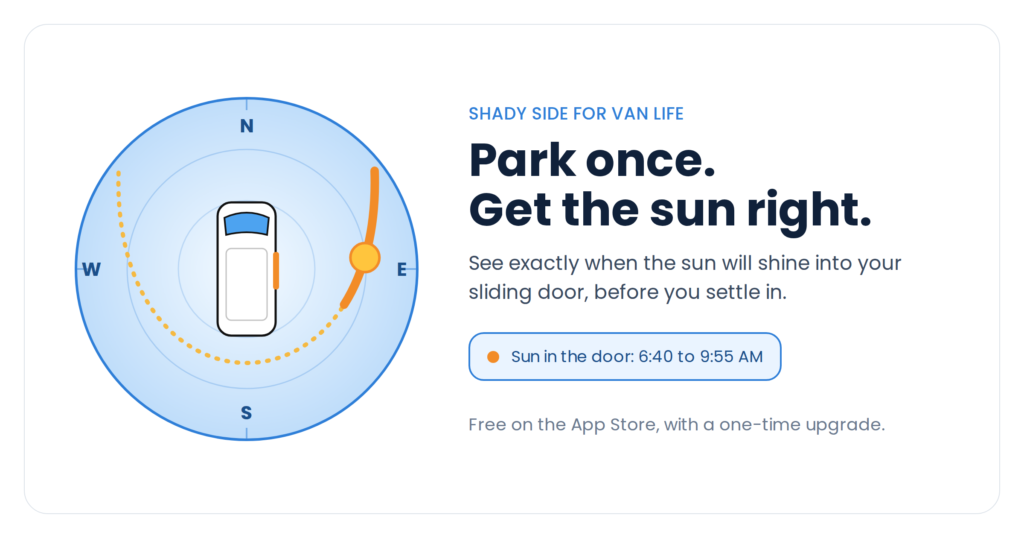
Shady Side for Van Life shows you where the sun will be all day wherever you’re parked, so you can aim your portable panels right the first time. It also shows when the sun will shine into your van’s sliding door, which is great for figuring out which way to park your van. It’s free, with a one-time upgrade that unlocks panel aiming and planning ahead.
Portable vs. Roof-Mounted Solar for Van Life
I started out with portable panels in addition to my roof panels, and I got rid of them. They took up too much space in the van, and I was tired of rotating them around chasing the sun. The roof panels are set-and-forget, and that’s more my speed.
How they stack up:
- Portable panels win on flexibility. You can park the van in the shade and set the panel out in the sun, which is a great trick in hot weather. You can also aim them, so you get more power per panel.
- Roof panels win on convenience. They’re always up there working, even while you drive. No setup, no storing them, no worrying that the wind will knock one over or that somebody will walk off with it.
- Roof panels lose in the shade. If you park under a tree, your roof panels are useless. I always park out in the open for my solar and Starlink, even on hot days when a shady tree looks SO good.
- Roof panels lose a little in winter. Mine are flat, and I definitely notice a big difference in how much power I get in summer vs. winter, because the low winter sun hits flat panels at a bad angle.
I have 200 watts on my roof (two 100W panels). It runs my DC fridge, my MacBook Air, my phone, and my string lights. I’ve never measured exactly how much power I use, because it’s mostly just worked. If I were doing it all over again, I’d put 400 to 600 watts up there, though. More is better when the sun doesn’t cooperate.
What Happens When There’s No Sun?
In three years, I’ve run my solar battery dead maybe 10 times, tops. Most of those were my own fault: I’d plug Starlink into it and forget to turn it off overnight, and wake up to a dead battery. Now Starlink lives on a totally separate battery that charges off my alternator, so it can’t drain the battery my fridge depends on.
That second battery is my backup plan, and it’s the reason a gray week like this one isn’t a big deal. I use a DC-DC charger (the Bluetti Charger 1 on my Anker battery), which charges the battery off the van’s alternator while I drive. It was super easy to install, and I can top off my solar battery from it when the clouds won’t quit.
I’ve also tried a gas generator, and nope. It’s so noisy, and it stinks of gas even when you set it an extension cord’s length away. If you want a backup, I’d get a DC-DC charger long before a generator.
Winter Solar: Snow, Short Days, and Climbing on the Roof
Winter solar is a whole different game. The days are short, the sun is low, and every now and then, you get snow on your panels.
One May, I was up in the mountains in California when it snowed out of nowhere, and I had to climb up on the roof and brush off my Starlink and solar panels. Can’t have them blocked! (You can see it on my Instagram.) A panel covered in snow makes basically nothing, so if you camp where it snows, get used to climbing up there with a brush.
A few winter tips:
- Brush off snow and frost as soon as you can. Even a thin layer cuts way down on your power.
- Tilt portable panels steep. It helps them catch the low sun, and snow slides off more easily.
- Expect less power, and have a backup like a DC-DC charger for the gray stretches.
Aiming Portable Solar Panels: Quick Checklist
- Face them south (true south, not magnetic south if you want to get picky).
- Tilt them about as steep as your latitude, steeper in winter and flatter in summer.
- Keep them out of the shade, including the van’s own shadow.
- Set it once or re-aim three times a day with Shady Side so you’re not guessing.
- Brush off snow and frost first thing.
- Have a backup for gray weeks. A DC-DC charger beats a stinky generator.
- Going roof-mounted? Get more watts than you think you need, and park in the open.
For more on staying powered up, check out my internet setup, where I break down the power math for Starlink and my laptop.
Sources
- U.S. Energy Information Administration: Solar photovoltaic output depends on orientation, tilt, and tracking
- National Renewable Energy Laboratory: PVWatts Calculator
Leave a Reply