
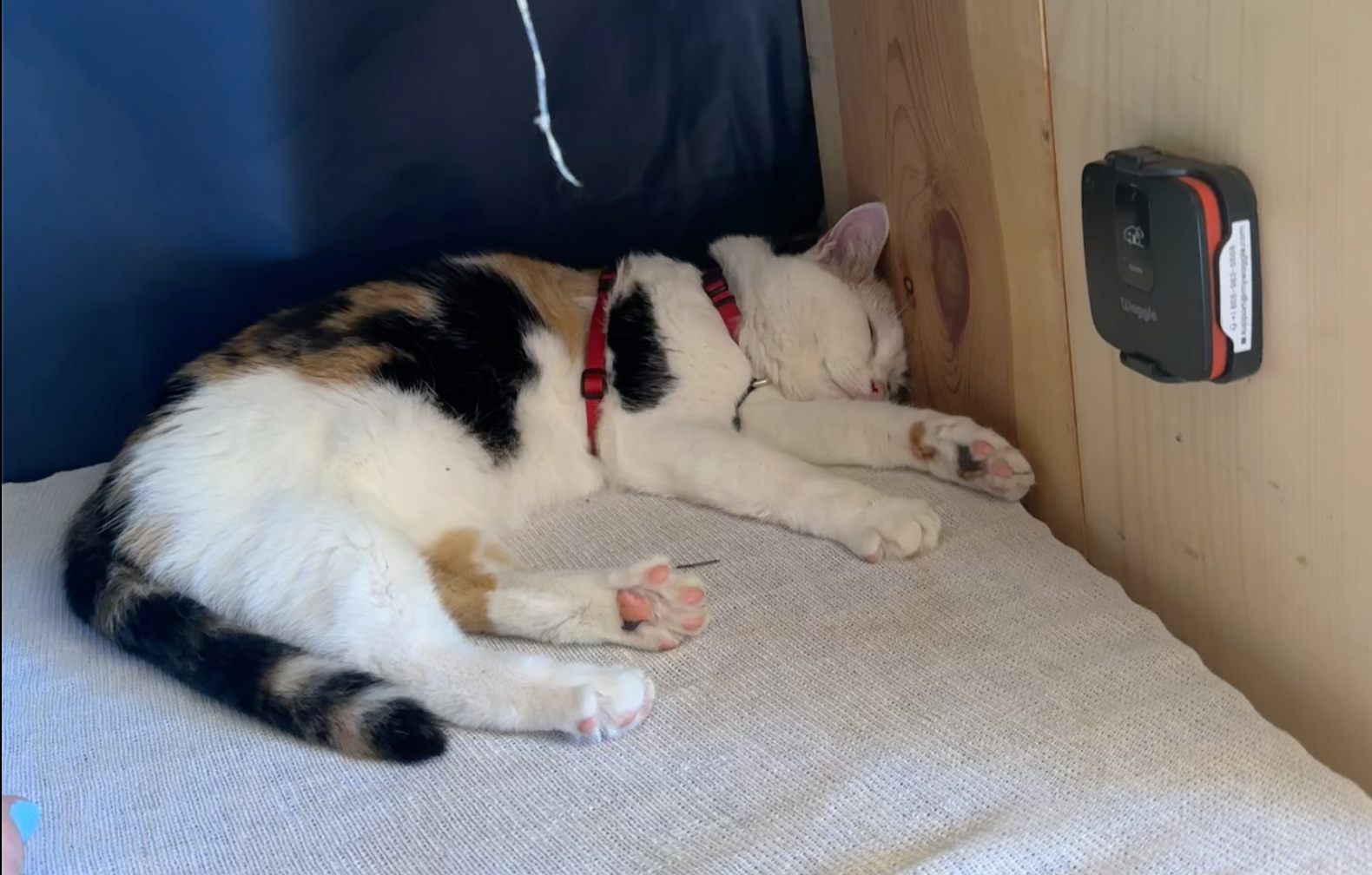
Summer is the season van lifers dream about all winter. But if you travel with cats, summer is also the season that demands the most from you.
Like all divas, cats hide discomfort. They won’t tell you they’re too hot until they’re already in trouble, and by then, the clock is ticking.
If you’ve ever watched your cat go flat on the floor in the heat and felt that spike of concern, I’ve been there. My first summer on the road, I learned this lesson the hard way with my girls, Boudica and Pooka.
The good news: overheating is one of the most preventable emergencies in van life.
In this post, I’ll tell you how to spot the early signs of heat stress in your adventure cat, exactly what to do the moment you see them, and how to build a travel life where it rarely happens in the first place.
Why Adventure Cats Overheat So Quickly
Cats are desert-descended animals, and they’re better at handling warmth than dogs. But they have limits, and a vehicle exacerbates that.
A van, RV, or car heats up fast, holds that heat, and often has less airflow than a house. Add travel stress, and your cat’s risk climbs.
A cat’s normal body temperature runs between 100.4 and 102.5 degrees Fahrenheit (38 to 39 degrees Celsius), and according to CatWatch, the newsletter produced with the Cornell University College of Veterinary Medicine, cell damage can begin once that temperature reaches 105 degrees F (40.5 degrees C) or higher. That gap is smaller than it sounds, especially inside a metal box parked in the sun.
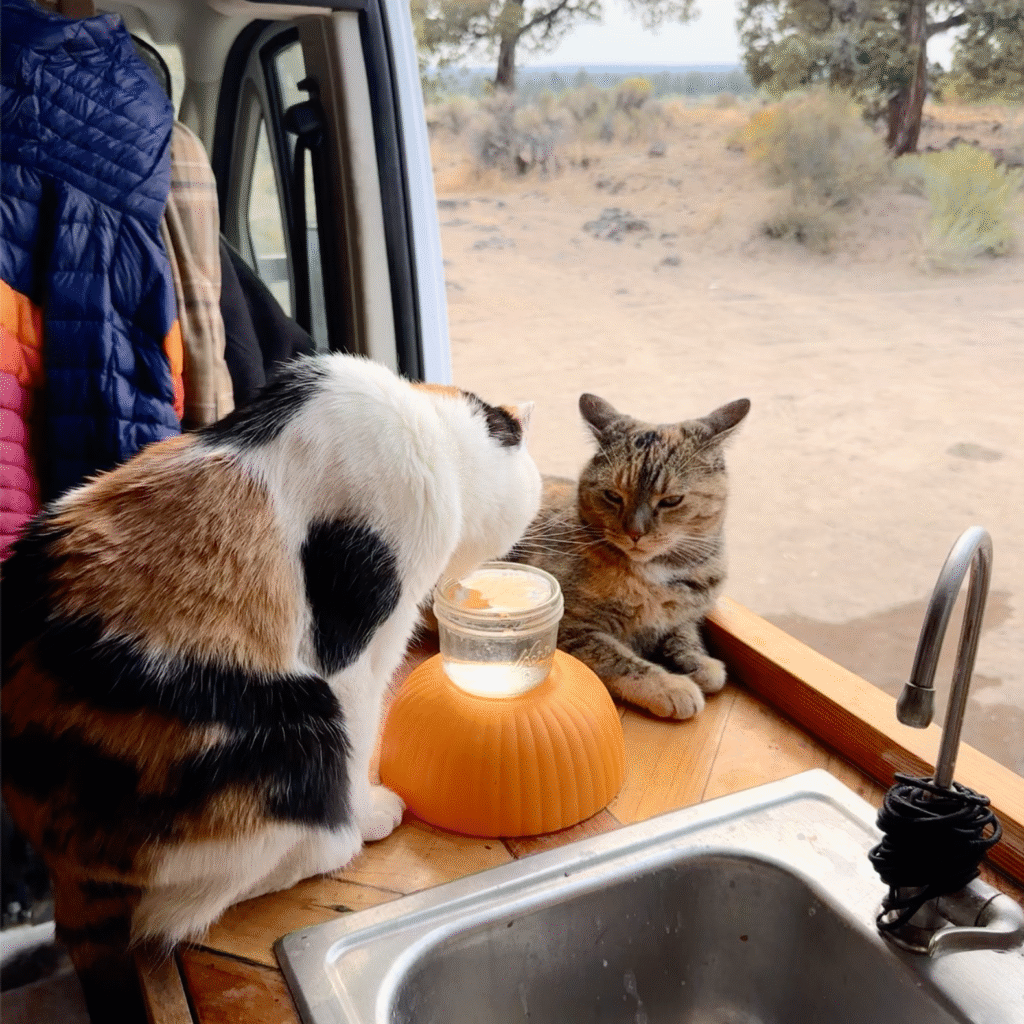
And some cats are at higher risk than others. My Pooka is a brown torbie with dense fur and a little extra chub, and she overheats before her sister every time. Boudica, my calico, is leaner and handles warm days better. Know which of your cats runs hot. Flat-faced breeds, seniors, kittens, overweight cats, and cats with thick coats all need extra attention.
Signs Your Cat Is Overheating
The Cornell Feline Health Center lists the signs of heat stroke in cats as excessive panting, drooling, weakness or collapse, vomiting, and diarrhea. Heat stroke can become life-threatening quickly, so these are stop-everything-and-help-your-kitty signs.
But your goal is to catch trouble long before that list. This is the progression I watch for.
Early Signs of Heat Stress
- Restlessness, searching for cool surfaces
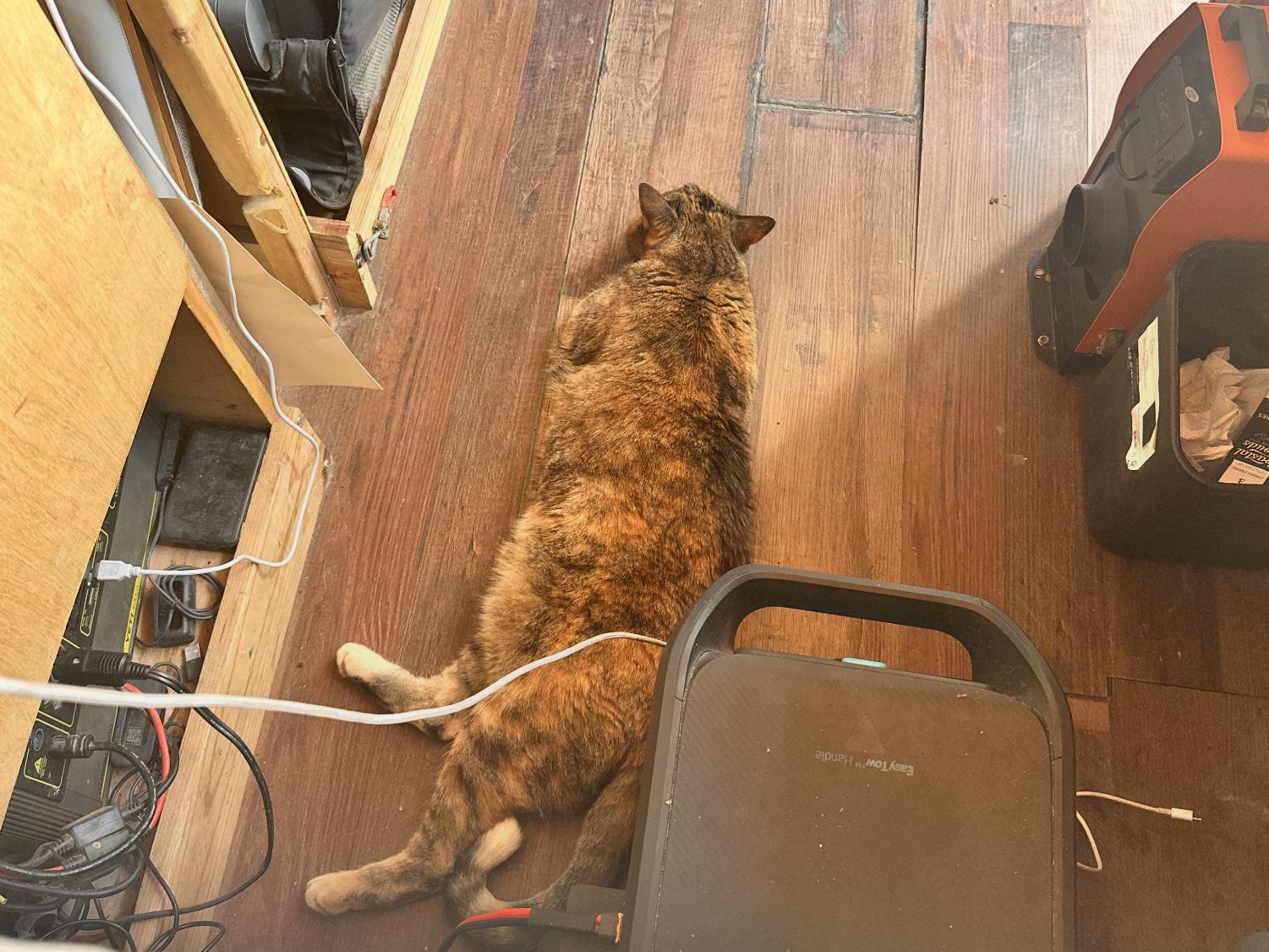
- Sprawling flat on their side on the floor (hot cats essentially turn into a liquid)
- Grooming more than usual (cats cool themselves through saliva evaporation)
- Sweaty paw pads leaving little prints
- Breathing faster than normal
- Sitting in the litter box to keep cool
When Pooka gets hot, she turns into a puddle. She flattens out on the coolest patch of floor she can find and stops being herself. That puddle posture is my first alarm bell.
Emergency Signs
- Open-mouth panting
- Drooling
- Lethargy, wobbling, or collapse
- Vomiting or diarrhea
- Bright red gums
A panting cat isn’t like a panting dog, even though they look like it (Pooka pants with the best of ’em). Cats pant only when something’s wrong. So if you see it alongside lethargy, treat it as an emergency.
Train Your Senses, Not Just Your Cat
Everyone talks about training adventure cats. Fewer people talk about training yourself.
Study your cats early and often. Learn their routines, their patterns, their tail language, their normal. Be obsessive about it.
The whole game of catching heat stress early is noticing the moment your cat’s behavior goes off script. I knew Pooka was in trouble in seconds because “puddle on her side at 2pm in a hot van” wasn’t her normal. She also wasn’t as energetic as she usually is.
Your attunement is your best safety equipment, and it’s free.
What to Do the Moment You Spot Overheating
My first year of van life, I stopped for a day at an empty campground in Missouri while driving from the hot and humid East Coast to the less-punishing high-elevation mountains out West. We really needed a break.
It was the girls’ first week on the road, and they weren’t used to the environment just yet. Pooka exhausted herself running around the campground, and soon she started panting, went lethargic, and plopped onto her side. What worked for us, backed by what veterinary sources recommend:
Step 1: Get Them Somewhere Cooler
Move your cat out of the sun and into the shadiest, breeziest spot available. Open doors and windows, run your fans, park in shade if you can move the vehicle. Airflow matters as much as temperature.
Step 2: Offer Water, but Don’t Force It
I brought Pooka water and she drank, which helped her turn a corner. Boudica refused to drink, which brings me to step three.
Step 3: Cool Them With Water on Their Fur
For my water-refusing Boudica, I sprinkled cool water on her fur. She kept licking it off, which did double duty: it got water into her and cooled her through evaporation. I also wetted both girls’ ears and noses with a damp wash cloth.
Cornell recommends this same approach: place the cat in a cool, drafty area and gently wet the fur with cool water (not ice-cold water). Very cold water can constrict blood vessels and work against you. Damp cloth wipe-downs, cool water on the paws and belly, and a fan blowing across damp fur all help.
Step 4: Call a Vet if Emergency Signs Appear
If your cat is panting heavily, collapsing, vomiting, or not improving within a few minutes of cooling, contact a veterinarian immediately. Organ damage from heat stroke can show up days later, so even a cat who seems recovered deserves a vet call after a serious episode. Before every travel leg, I note the nearest emergency vet, a tactic I recommend.
How to Prevent Overheating in a Van Without AC
My van doesn’t have house air conditioning, meaning no AC separate from the cab. Prevention is my whole strategy, and it’s worked for the past 3 summers.
Chase Elevation or Coastline
The simplest way to keep your cats cool is to not be in the heat.
I work remotely, so every summer, I head above 9,000 feet. The Rockies and the Sierra are full of high-elevation camping spots where July afternoons stay comfortable: Grand Mesa in Colorado, the high country of Montana and Utah.
The other option is the coast. The Oregon coast is a crazy beautiful place to wait out summer, though it’s more crowded and more campground-dependent than the mountains.
Whatever you do, stay out of the desert from June through September!
Build Airflow Into Your Rig
I installed two bunk windows on either side of my van bed, and it was one of the best upgrades I’ve made. Cross-breeze at night, plus the cats and I love watching the world from bed.
Pair windows with a roof fan (I run a MaxxAir) and a couple of rechargeable 12-volt fans, and you can move a surprising amount of air through a small space.
Block the Sun Before It Gets In
DIY Reflectix window covers help immensely. The sun you never let in is heat you never have to fight. Cover every window when parked in sun, especially the windshield.
Keep Water Everywhere
International Cat Care advises keeping fresh water available at all times in hot weather, replacing it several times a day, and putting out multiple bowls so water’s always within easy reach.
In a van, that means at least two bowls in different spots, refreshed often. A fountain can encourage reluctant drinkers, and wet food adds hydration too.
The Grocery Store Problem
Never leave your cats in a parked, closed vehicle in the heat. Even a few minutes can be dangerous.
When I MUST shop in 100-degree town heat, I leave the van running with the cab AC on. I carry two key fobs, so I can lock the running van with one and keep the other in my pocket.
Idling isn’t great for the engine or the planet, but for a short errand with lives inside, it’s the right call.
Another option is to prioritize errands in the early morning or the evening after the sun has set if you’d rather not idle.
Work With Your Cat’s Natural Rhythm
Cats already know how to avoid the heat. Your job is to build a routine around their instincts instead of fighting them.
- At camp in summer, my van doors open at 7am. The girls go out, play, and patrol while I walk with them.
- By 10:30, they’ve had their fill, the day is warming, and they come inside on their own to sleep through the hot hours.
- Around 4pm, as things cool off, they’re ready for round two.
- By 7pm it’s dinner and the door closes for the night.
I didn’t force this schedule. I noticed it and protected it.
One more thing, and it matters more than any gear: make your cat feel safe. Don’t reprimand them when they do something you don’t want. They probably have no idea what’s going on. Prove to them, every day, that you and the van are their safe space where they’ll never encounter weird rage. A cat who trusts you comes when called, retreats to the van when stressed, and lets you handle them when an emergency hits. If they don’t feel safe, you’ll be chasing them a lot more than you’d like, and in a heat emergency, minutes count.
Be Aware And They’ll Know You Care!
Watch for panting, drooling, lethargy, and the dreaded puddle posture. Cool an overheated cat with shade, airflow, and cool water on the fur, and call a vet if emergency signs appear. Then build a life where it rarely comes up: chase elevation, move air, block sun, keep water out, and follow your cat’s rhythm. Boudica, Pooka, and I have logged a lot of hot miles since that Missouri campground, and we haven’t had another scare. You and your adventure cat can do the same.
Sources:
- Cornell Feline Health Center, Feline Heat Safety
- CatWatch (Cornell University College of Veterinary Medicine Feline Health Center), Hot Weather Care
- International Cat Care, Hazardous Weather and Your Cat
Leave a Reply