
If you spend any time in the van life corners of the internet, you already know the two questions that get asked every single day:
How do you afford this?
What do you do for work?
They’re good questions. They’re also usually answered badly, by people who could only dream of living life on the road. It’s either with a vague gesture at “passive income” or with the kind of highlight-reel non-answer that leaves you more confused than when you started. And let’s not forget the accusations that we’re all trust-fund babies. As someone who worked really hard to become this homeless, major eye-roll.
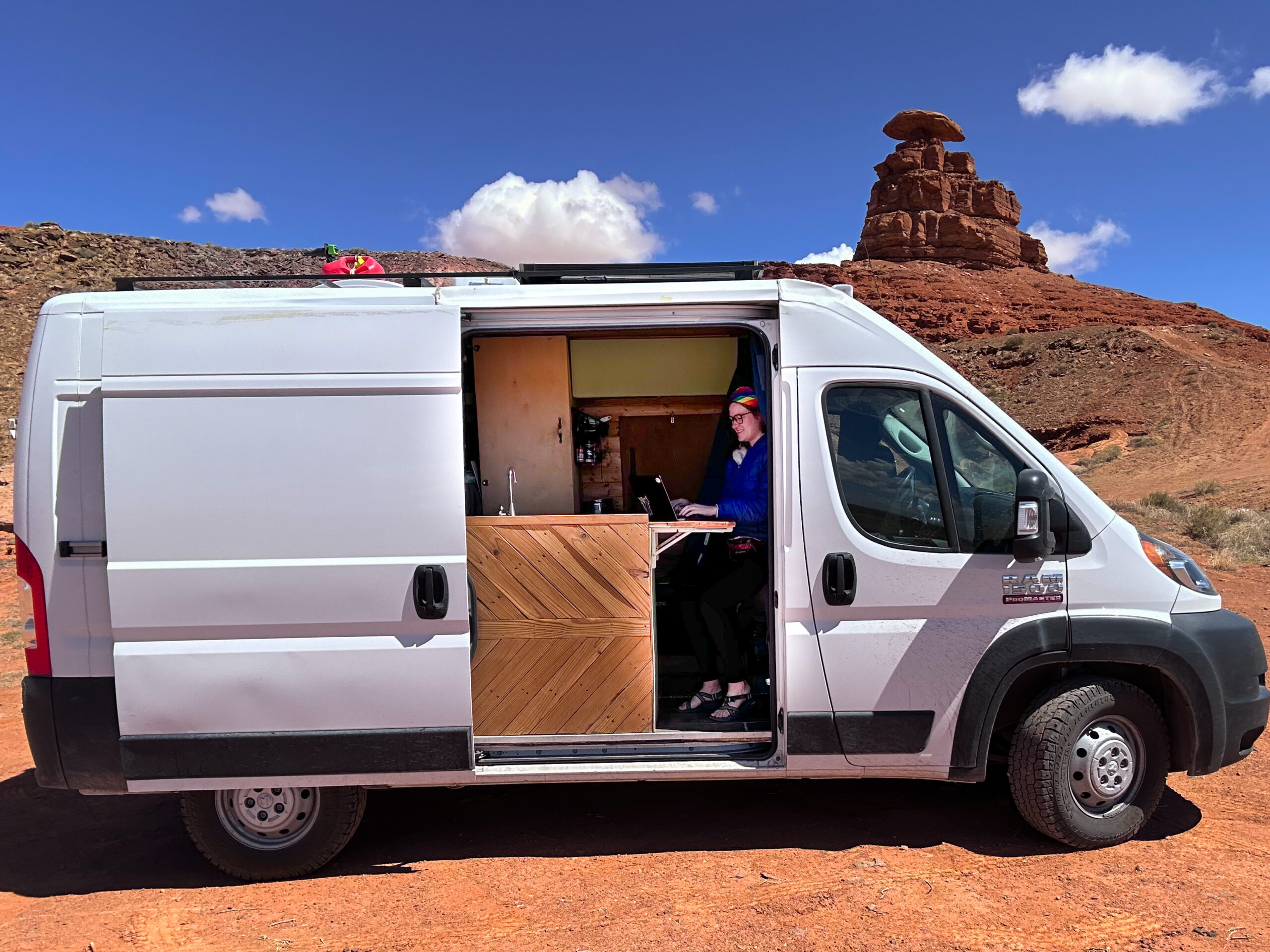
So, my answer: I have a full-time job. A regular, salaried, meetings-on-the-calendar 9-to-5 at a digital marketing agency out of Nashville. I work it from a campsite via Starlink. Then I close the laptop and go stand in a river.
That’s the whole trick. I know it’s not glamorous. Stay with me, because I think it’s the most useful answer I have, and then I’ll get into all the paths that aren’t mine, like seasonal park jobs, camp hosting, workamping, because those are real and people I love are living them right now.
It Ain’t The “Buy a Rig and Quit Your Job” Fantasy
The version of van life that gets sold on Insta and TikTok is: quit your job, sell your stuff, and go enjoy your life. Well, life isn’t very enjoyable when you’re burning through your savings. Eventually, you’re gonna need a job.
But van or RV life does change the shape of your expenses.
Instead of rent, you have a vehicle that will eventually need something expensive (currently writing this from a Red Roof Inn while the van is at the dealership!).
Instead of a utility bill, you have connectivity, and it isn’t cheap. The freedom is real (I’m not being cynical here, I chose this and I’d choose it again tomorrow) but it comes from the ratio between what you earn and what you spend, not from escaping the equation.
So the question isn’t really “how do you afford van life.” It’s two separate questions: how do you keep earning while moving, and how low can you get your costs. Every person you see out here has solved both, whether or not they talk about it.
My Answer: Freelancing + Remote Work
According to the U.S. Bureau of Labor Statistics, 22.6% of workers teleworked or worked at home for pay in March 2026. That’s more than one in five American workers. Remote work isn’t an exotic van life hack anymore. It’s a fifth of the labor force. You are not asking for something unreasonable.
I was genuinely terrified nobody would hire me if they found out I lived in a van. I built up whole arguments in my head about how I’d hide it. Then I found an agency that thought it was cool, and I’ve been grateful for that every day since. Not every employer will react that way, and I had some awkward job interviews because of it. But all you need is one.
On video calls, I just blur my background. You can’t tell it’s a van, and anyway, half the people on my calls are running a fake background from a spare bedroom. Nobody’s scrutinizing your walls.
My best van life upgrade was a Starlink. When I was relying on cell coverage alone, my map of possible places to be was tiny, and I love being deep in nature, far from people. Starlink Roam blew that map wide open. Outages are rare enough that connectivity has essentially stopped being a thing I worry about. All I need is a relatively open sky and I’m good to go!
Why The 9-5 Works For My ADHD
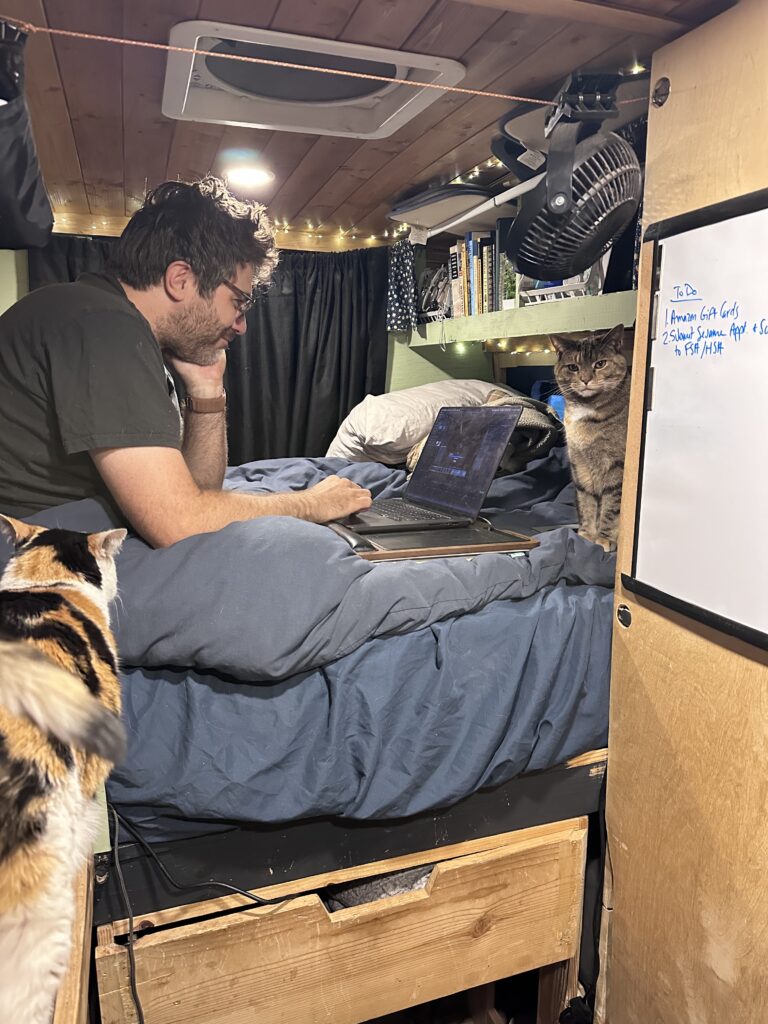
I was freelancing when I started van life. On paper, freelancing is the perfect nomad job: total flexibility, work when you want, move when you want. In practice, for my ADHD brain, it was rather stressful.
With no external structure, I’d move campsites for no reason. I’d get anxious about a project and then procrastinate by driving an hour to town to do laundry. I was often rattled by the lack of stable income. It was exhausting in a way that’s hard to explain to people who assume flexibility is inherently a gift.
The 9-to-5 gave me scaffolding I didn’t know I needed. Because I have to be somewhere stable and connected on Monday morning, I now stay put for a week or two at a time.
It’s helped me save money on gas, saved me an enormous amount of decision fatigue, and made my life feel calmer. The structure I resented in an office turned out to be the thing that lets me be nomadic sustainably.
In regards to seasonal work, it is awesome for some people, but it was hard for me. As an introvert who struggles with social skills, being “on” for tourists and customers for eight hours a day drained me and made me a person I didn’t really like. Add being tied to one location for a whole season, and I felt trapped and claustrophobic. I need to be able to explore freely or something in me starts clawing at the walls.
That’s me. It is absolutely not everyone, and the very next section is proof.
When It Comes to Van Life Jobs, You Have Options!
Not every job can be done from a campsite, and not everyone wants a job that can be. These are the paths I’ve watched real people pull off.
1. Seasonal Work Near or In National Parks
My friend started out working in the employee gym in Yosemite. Employee gym! That was her way in. She’s since landed her dream job: guiding backpacking groups between the High Sierra Camps. She is so happy. Her friends in the park work in restaurants, as interpretive guides, as rangers, and in a dozen roles I’d never have thought of.
Typically in seasonal work, room and board are provided. She’s not solving for rent at all. And she still owns her van, which she uses for weekend adventures. Her seasonal job and the nomad life aren’t in conflict, they take turns.
Where to look:
- CoolWorks: running since 1995, and the best single starting point. My friend got her start via this website, working a season in Kanab, UT and then another season guiding whitewater rafting in Colorado. She had no prior experience!
- The lodges, restaurants, and shops in the parks are run by private concessioners, not the Park Service, so that’s who you apply to. Yosemite’s is Yosemite Hospitality, and their openings are posted on CoolWorks here. Xanterra runs Yellowstone, Grand Canyon South Rim, Glacier, Rocky Mountain, Death Valley, and Mount Rushmore, and has a dedicated housing-and-meals program for employees. Neither company has a great reputation, but don’t let that discourage you. The adventure and the community you gain there seem rad (not for me, too many people, but good for her).
- For Park Service positions themselves (rangers, and the rest of the federal side), it’s USAJOBS. Individual parks also list opportunities directly. These jobs are more challenging to get a foot in the door, but you should apply anyway. After the Appalachian Trail, a young woman I hiked part of the way with got a job as a National Park ranger and she’s still serving today. The AT was her only experience.
Apply earlier than feels reasonable. Summer hiring often happens in winter.
2. Camp Hosting
You live at a campground, keep an eye on it, answer questions, clean up, and in exchange you get a site, often with hookups, and often a wage on top.
The confusing part is that camp host jobs come in two flavors.
- Volunteer positions are posted on Volunteer.gov, the shared portal for federal land agencies.
- Paid positions usually come from the private companies holding concession contracts on Forest Service and BLM campgrounds, the biggest of which is American Land & Leisure, which hires camp hosts directly across a lot of states.
If you have a specific campground in mind, look it up on Recreation.gov and find out who operates it, then go straight to them. These are cool jobs if you want hook ups and also do remote work, but I know people who keep their expenses low enough to float on camp hosting alone.
3. Workamping
The catch-all term for trading work for a campsite and usually some pay: campgrounds, RV parks, farms, attractions, and the great seasonal rushes, like sugar beet harvest, pumpkin patches, Christmas tree lots.
Workamper News has been the hub of this world since 1987. Be aware that the full job board is behind a paid membership; you can preview featured employers for free, so look before you pay.
4. Teach What You Know
My boyfriend, Alex Noriega, is a nature photographer who teaches one- and two-week workshops, often in national parks, every two or three months. Between them, he’s free to roam the country in his truck camper, and he’s been doing it for six or seven years now.
This is a model I think is underrated: instead of spreading your work thin across every week of the year, you compress it into intense bursts and buy back long stretches of unstructured time. It works for photography, but also for teaching, consulting, guiding, trades, and anything else where people will pay for concentrated access to your expertise. It requires having built something people want. It doesn’t require a huge audience.
5. Remote Job Boards, If You Want My Path
I got my start in tech and digital marketing by freelancing on Upwork. You have to take poorly paid gigs to start, but it’s easy to stand out once you get a few 5-star reviews under your belt. The market is saturated; that’s not a bad thing! My consistency, quality of work, and dedication made clients eager to lock me into long term contracts.
For strictly remote work, We Work Remotely is the biggest job board and free to browse. But search on the ordinary boards like LinkedIn, too. The number of fully remote roles that never get labeled “digital nomad friendly” is enormous. Mine wasn’t advertised as a van life job. It was advertised as a job. I got it via LinkedIn.
Let’s Talk Van Life Expenses
I don’t feel like I’m scraping by. I feel rich. But I’ve thru-hiked two long trails while living out of a backpack; it doesn’t take much for me to feel comfortable while keeping my expenses low.
My biggest fixed costs are phone and internet. Indeed, connectivity is genuinely my largest monthly line item. I pay Verizon $100/month for unlimited data and Starlink Roam is now $175/month (as of this writing). I plan to switch to Visible next month which should cut my cell bill down to around $30/month. It’s still kinda rough, but so worth it when my office is a beautiful wooded mountain-side campsite.
There’s also gas, of course. My first year I drove around like crazy, easily spending $500-$1000 per month on gas. These days, I have enough resources to stay put for a week or two (at the longest), which is saving me tremendously on gas expenses. I probably max out around $300 a month. MAX.
After that, my real spending goes to hobbies I picked up out here and don’t regret for a second: a gaming laptop, a MacBook Pro for photo and video editing, a Canon R7 with a 100-500mm lens for wildlife photography. For many van lifers, their expensive van life hobbies are more likely to include climbing equipment, paddling boats and accessories, backpacking gear, or even dirt bikes and ATVs. No matter who you are, you’ll find a hobby to drain your funds. And it’ll be well worth it!
None of that would exist if I were handing someone two grand a month for an apartment. That’s the real mechanism. Not a just clever income stream (even with my 9-5, I don’t earn a lot. DM me on Instagram and I’ll tell you what I make.). It’s a radically smaller denominator. Low overhead is what turns an ordinary salary into a life with a telephoto lens in it.
Don’t Listen To Them!
My whole life, people told me it wasn’t possible to do what I’m doing. What all of us out here are doing.
They said it about my friend, who is currently getting paid to walk people through the High Sierra. They said it about Alex, 10 years into making nature photography his career. They said it to me, and I believed them long enough to be scared of applying for jobs I was completely qualified for.
There are many paths to a life spent outside. Remote work is one. Seasonal park work is one. Camp hosting is one. Teaching in bursts is one. What they have in common is that somebody decided the conventional version of their life wasn’t the only version available, and then made it happen.
The logistics are manageable. That’s the whole message.
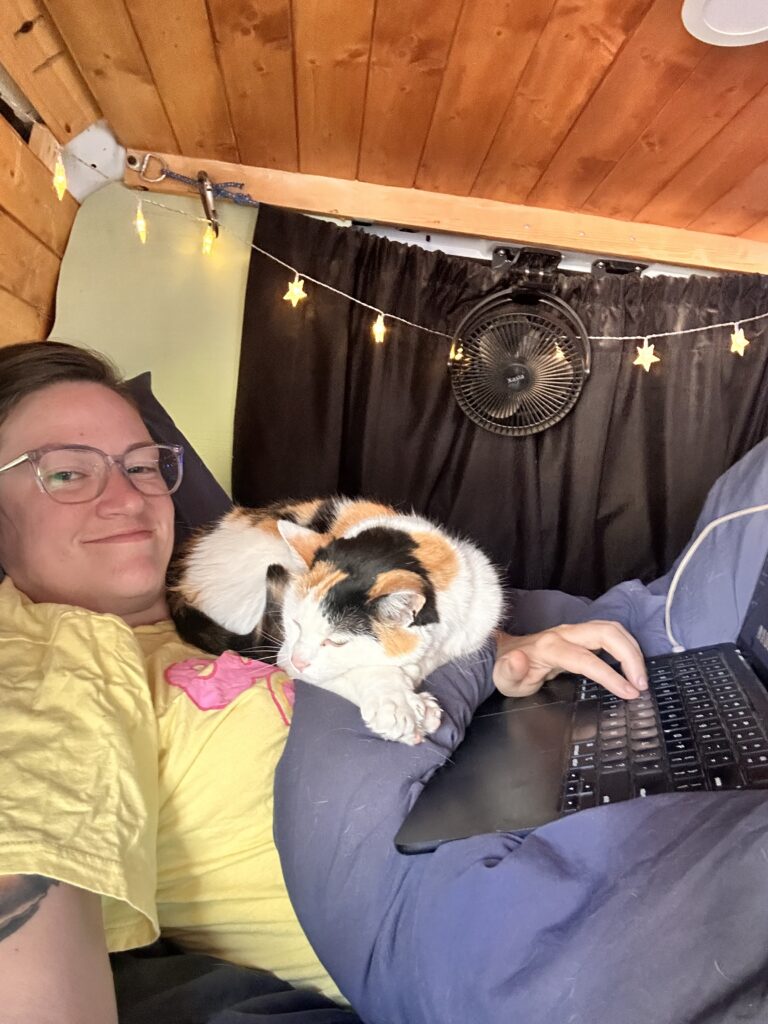
Boudica and Pooka contributed nothing to this article but were present for all of it.
Sources:
- U.S. Bureau of Labor Statistics, 22.6 percent of workers teleworked in March 2026
Leave a Reply